
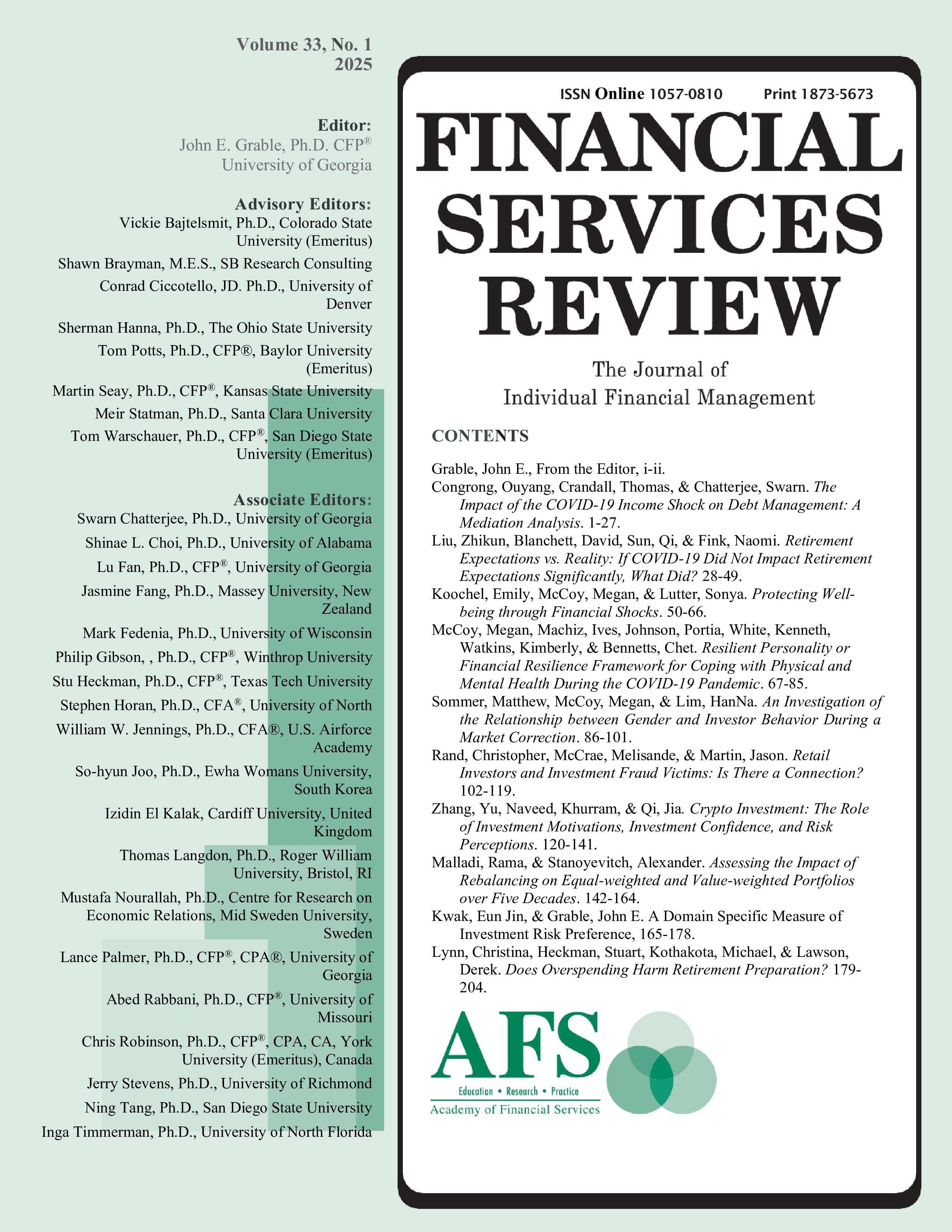
Retirement Expectations vs. Reality: If COVID-19 Did Not Impact Retirement Expectations Significantly, What Did?
Factors that Impact Retirement Decisions
DOI:
https://doi.org/10.61190/fsr.v33i1.4052Keywords:
Financial Planning, Retirement, Consumer behavior, Decision making, Defined contributionAbstract
Using two data sets (a Prudential Financial Wellness Survey and the Health and Retirement Study), this study demonstrates that although there is generally a natural upward trend for older (age 50+) Americans to progressively delay their expected retirement age, this trend has no statistically significant relationship with the COVID-19 pandemic. The distribution of older Americans’ expected retirement ages is bimodal, often centered around two Social Security Benefit claiming ages – the early retirement age and full retirement age. However, actual retirement ages are more likely to follow a left-skewed distribution, whereby people appear to retire earlier than expected. The most significant factors that influence participants’ retirement decisions relative to expectations are health (+), wealth (-), age (+), change of marital status (+), mortality expectations (+), education levels (+), disability (-), and major illness diagnosis (-). Focusing on these factors can help the retirement benefits community explore strategies to mitigate the negative consequences of gaps between retirement expectations and reality.
* “(-)” means the impact is negative, i.e., retire earlier than expected, and “(+)” means the impact is positive.
Downloads
Downloads
Published
Issue
Section
License
Copyright (c) 2024 Zhikun Liu, Ph.D., CFP®, David Blanchett, Ph.D., CFP®, CFA, Qi Sun, Ph.D., CFP®, Naomi Fink, MA, MSc, FRM

This work is licensed under a Creative Commons Attribution-NonCommercial 4.0 International License.
Author(s) retain the copyright and full publishing rights without restriction.
Author(s) grant the Journal right of first publication with the work simultaneously licensed under a Creative Commons Attribution-NonCommercial 4.0 International License that allows reusers to distribute, remix, adapt, and build upon the material in any medium or format, for noncommercial purposes only. Reusers must acknowledge the work's authorship and initial publication in this Journal.
Noncommercial means not primarily intended for or directed towards commercial advantage or monetary compensation.
In addition, FSR grants to the UGA Libraries a worldwide, non-exclusive license to all content published by the Journal, including metadata, that is necessary to publish, transmit, and index the Journal and to preserve its content over time.