
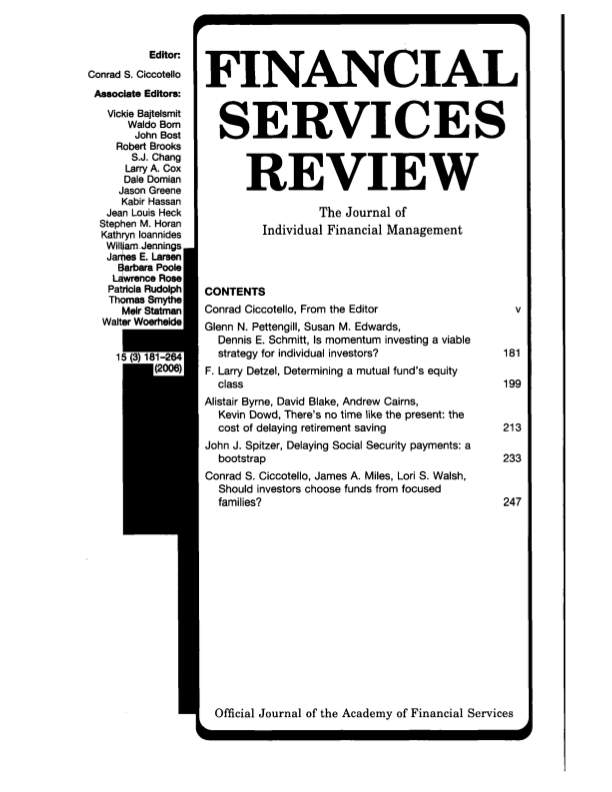
Delaying Social Security payments
DOI:
https://doi.org/10.61190/fsr.v15i3.4860Keywords:
Bootstrap, Delayed benefits, Social Security, Asset allocationAbstract
This paper reconciles previous research outcomes and explains why prior studies offer conflicting recommendations regarding the decision to delay Social Security payments. Using a bootstrap, this paper determines the age at which a retiree is better off deferring Social Security payments when rates of return are not constant. The expected rate of retum affects the breakeven age and the rate of retum is a function of asset allocation. When life expectancy and realistic investment retums are incorporated into the analysis, there are few circumstances that warrant postponing Social Security payments for early retirees.
Downloads
Downloads
Published
Issue
Section
License
Copyright (c) 2006 Academy of Financial Services

This work is licensed under a Creative Commons Attribution-NonCommercial 4.0 International License.
Author(s) retain the copyright and full publishing rights without restriction.
Author(s) grant the Journal right of first publication with the work simultaneously licensed under a Creative Commons Attribution-NonCommercial 4.0 International License that allows reusers to distribute, remix, adapt, and build upon the material in any medium or format, for noncommercial purposes only. Reusers must acknowledge the work's authorship and initial publication in this Journal.
Noncommercial means not primarily intended for or directed towards commercial advantage or monetary compensation.
In addition, FSR grants to the UGA Libraries a worldwide, non-exclusive license to all content published by the Journal, including metadata, that is necessary to publish, transmit, and index the Journal and to preserve its content over time.