
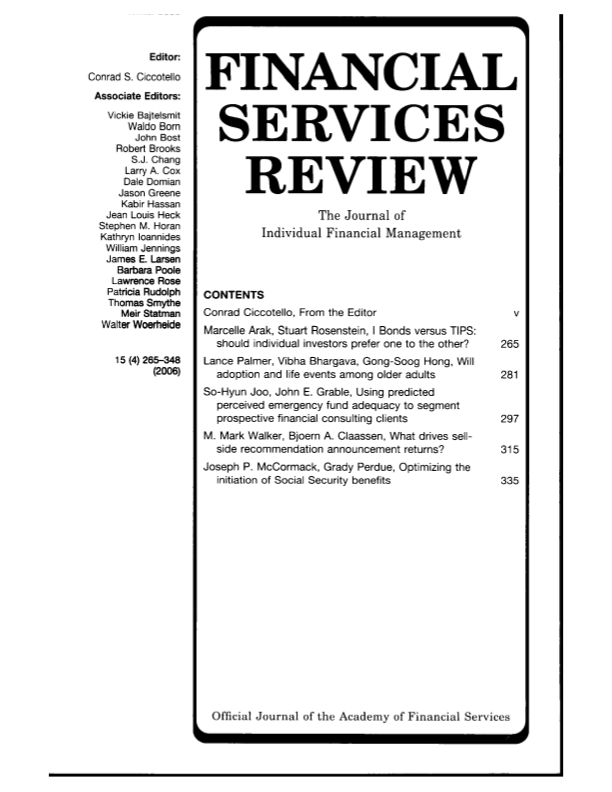
What drives sell-side recommendation announcement returns?
DOI:
https://doi.org/10.61190/fsr.v15i4.4867Keywords:
Behavioral finance, Analysts’ recommendationsAbstract
Before an individual investor follows a professional stock analyst’s investment recommendation, the Securities and Exchange Commission (2005) urges the investor to consider carefully the potential conflicts of interest facing the analyst. Our study examines this issue in the context of Griffin and Tversky’s (1992) model that explores how individuals weigh evidence and form beliefs. We find that although investors focus primarily on recommendation strength following upgrades, investors con- sider both recommendation strength and credence following downgrades. However, we find no evidence that stock price performance is affected by any underwriting relationship between the firm employing the analyst and the firm being recommended.
Downloads
Downloads
Published
Issue
Section
License
Copyright (c) 2006 Academy of Financial Services

This work is licensed under a Creative Commons Attribution-NonCommercial 4.0 International License.
Author(s) retain the copyright and full publishing rights without restriction.
Author(s) grant the Journal right of first publication with the work simultaneously licensed under a Creative Commons Attribution-NonCommercial 4.0 International License that allows reusers to distribute, remix, adapt, and build upon the material in any medium or format, for noncommercial purposes only. Reusers must acknowledge the work's authorship and initial publication in this Journal.
Noncommercial means not primarily intended for or directed towards commercial advantage or monetary compensation.
In addition, FSR grants to the UGA Libraries a worldwide, non-exclusive license to all content published by the Journal, including metadata, that is necessary to publish, transmit, and index the Journal and to preserve its content over time.