
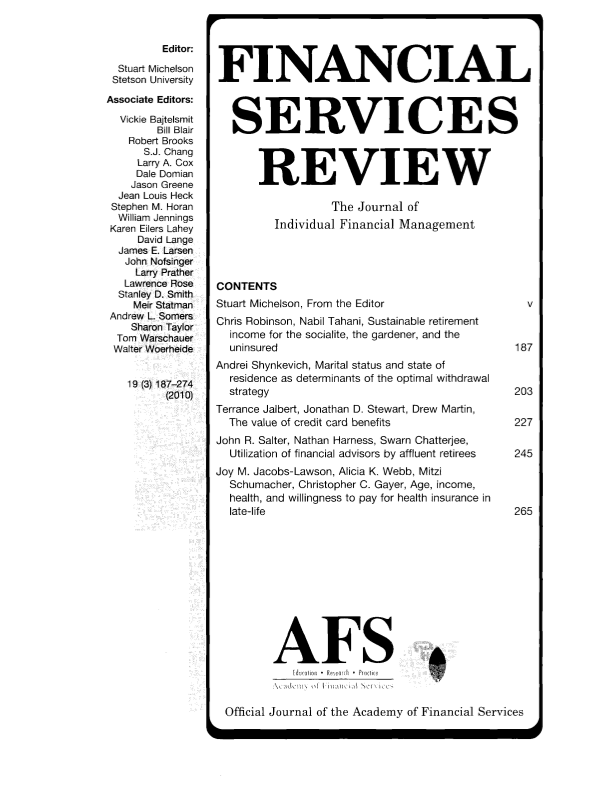
Sustainable retirement income for the socialite, the gardener, and the uninsured
DOI:
https://doi.org/10.61190/fsr.v19i3.4974Keywords:
Stochastic consumption, Sustainable retirement, Stochastic present value, Probability of ruinAbstract
This paper advances the literature on the sustainability of retirement income by making consumption a stochastic variable instead of a constant real value, as previous papers have done. The paper continues to make the rate of return and date of death stochastic variables, as Milevsky and Robinson (2000, 2005) do. The sustainability of retirement income depends on the nature of the lifestyle that the retiree chooses. The difference in shortfall probabilities or risk of ruin between the variable cases and the fixed consumption case is significant, and so the adviser needs to take this into account. The difference in shortfall probabilities between making consumption a nonconstant but deterministic amount, and making it also stochastic, is not as important, because it does not reduce risk enough to make more aggressive consumption rates secure. Finally, making consumption correlated with the rate of return, which implies the family adjusts consumption as its wealth changes, reduces shortfall probabilities to a moderate extent. In general, an initial consumption of more than 4% of initial wealth is not sustainable for any likely set of conditions. In the very best case, an initial consumption rate of 6% is sustainable, but we think that case will fit very few people.
Downloads
Downloads
Published
Issue
Section
License
Copyright (c) 2010 Academy of Financial Services

This work is licensed under a Creative Commons Attribution-NonCommercial 4.0 International License.
Author(s) retain the copyright and full publishing rights without restriction.
Author(s) grant the Journal right of first publication with the work simultaneously licensed under a Creative Commons Attribution-NonCommercial 4.0 International License that allows reusers to distribute, remix, adapt, and build upon the material in any medium or format, for noncommercial purposes only. Reusers must acknowledge the work's authorship and initial publication in this Journal.
Noncommercial means not primarily intended for or directed towards commercial advantage or monetary compensation.
In addition, FSR grants to the UGA Libraries a worldwide, non-exclusive license to all content published by the Journal, including metadata, that is necessary to publish, transmit, and index the Journal and to preserve its content over time.