
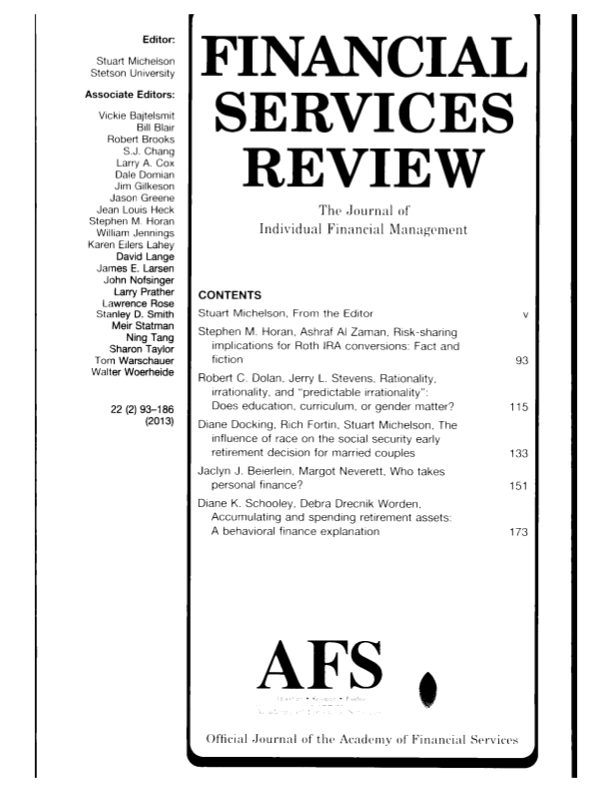
The influence of race on the social security early retirement decision for married couples
DOI:
https://doi.org/10.61190/fsr.v22i2.4648Keywords:
Race, Age, Married couples, Benefit optimization, Optimal retirement age, Social securityAbstract
There has been an extensive amount of research into the social security early and delayed retirement decision for married couples. The results have been mixed. This article extends the analysis of prior research to the early and delayed retirement decision for married men and women. We analyze the decision for married couples by race. More specifically, we analyze the nine married couple combinations for the following races: Whites (W), Hispanics (H), and Blacks (8). The nine husband/ wife combinations are: WW, BB, HH, WB, BW, WH, HW, BH, and HB. We develop an Excel model to compute the breakeven (BE) internal rate of return (IRR) for each of the nine race combinations from age 62 through age 70. The BE IRRs can be interpreted as follows: If a couple's opportunity cost of capital (that can be considered a hurdle rate) is greater than (less than) the computed BE IRR, the couple should retire at the earlier (later) age. This study is limited to same age couples and we compute the BE IRR starting: at age 62 for all other years through age 70, at age 63 for all other years through age 70, at age 64 for all other years through age 70 and so on. Our results are fairly uniformly consistent across the nine race combinations: BE IRRs for a given "base age" are, in general, monotonically decreasing compared with older ages (the exceptions are when comparing age 62 to ages 63, 64, and 65). We conclude that, from a given base age, it is generally more optimal to retire now with a longer time horizon because the hurdle rate is lower and later with a short time horizon because the hurdle rate is higher.
Downloads
Downloads
Published
Issue
Section
License
Copyright (c) 2013 Academy of Financial Services

This work is licensed under a Creative Commons Attribution-NonCommercial 4.0 International License.
Author(s) retain the copyright and full publishing rights without restriction.
Author(s) grant the Journal right of first publication with the work simultaneously licensed under a Creative Commons Attribution-NonCommercial 4.0 International License that allows reusers to distribute, remix, adapt, and build upon the material in any medium or format, for noncommercial purposes only. Reusers must acknowledge the work's authorship and initial publication in this Journal.
Noncommercial means not primarily intended for or directed towards commercial advantage or monetary compensation.
In addition, FSR grants to the UGA Libraries a worldwide, non-exclusive license to all content published by the Journal, including metadata, that is necessary to publish, transmit, and index the Journal and to preserve its content over time.